CPQ to Revenue Cloud: A Practical Career Transition Guide
What transfers directly from Salesforce CPQ to Revenue Cloud, what's genuinely new to learn, and an honest look at certifications and job market demand.
Elena Savenko
Salesforce Developer
6 min read
·
July 30, 2026
I'm seeing more demand for people who understand this space. Companies are increasingly focused on subscription models, complex pricing, and revenue recognition.
– Evaldas Zaranka, a Salesforce Architect at Wise, told Salesforce Ben about Revenue Cloud perspectives earlier this year.
That's notable given the broader picture: global demand for Salesforce talent as a whole dropped 46% year-over-year, according to 10K Advisors' 2025 Salesforce Talent Ecosystem Report. Revenue Cloud is one of the few areas still pointing up while most of the ecosystem cools off.
Your CPQ experience isn't worth less. The label just changed. Here's what transfers, what's genuinely new, and how to learn it, from someone who's already made the move.
Key takeaways
Salesforce CPQ end of sale took effect in March 2025 – existing implementations keep running, but new investment, hiring, and roadmap work is going into Agentforce Revenue Management.
Core CPQ knowledge – bundles, discounting, approvals, quote logic – transfers directly. What expands is the scope: Revenue Cloud spans the full product-to-cash lifecycle, not only the quote.
The genuinely new areas are Product Catalog Management, pricing procedures and context definitions, and constraint modeling with CML. CML is the steepest curve of the four, and currently the hardest of them to hire for.
A realistic learning path combines Trailhead, the Revenue Cloud Consultant certification, and hands-on practice building constraint models – self-study alone rarely gets teams through the CML paradigm shift.
Why this transition is happening now
Salesforce CPQ end of sale was confirmed by Salesforce in March 2025. End of sale isn't the end of life – Salesforce stopped selling CPQ to new customers, not switching it off for the ones already running it.
Existing customers keep the licenses they have, keep support, and can still renew and add seats. What stops is new investment: no new CPQ features, and all forward-looking work – including AI-driven capabilities – going into Revenue Cloud, now increasingly referred to as Agentforce Revenue Management (ARM).
That's a business decision, not a technical verdict on CPQ itself. But it does change what "Salesforce CPQ career transition" looks like for anyone who built a specialization there: the tool you know isn't going away tomorrow, but the roadmap, the training investment, and – increasingly – the project pipeline are moving somewhere else.
The scope shift matters more than the rebrand.
CPQ was built around getting to a correct quote. Revenue Cloud is built around keeping an entire process consistent – catalog, pricing, quote, order, subscription, amendment, billing – as a single connected chain.
A configuration that works fine inside a quote can quietly break later when the same product becomes an order, an asset, or a renewal.
Salesforce CPQ skills that transfer to Revenue Cloud
CPQ experience is not a handicap here – it's a head start. Anyone who has implemented Salesforce CPQ already understands why pricing exceptions exist, why bundle logic gets complicated fast, and why discount approvals need real governance. That commercial fluency – reading a pricing requirement and knowing where it will get messy – transfers without modification.
What doesn't transfer as cleanly is the architecture.
The biggest risk in a CPQ-to-Revenue Cloud move is treating Revenue Cloud as "a newer CPQ" and porting old product rules, bundle structures, and pricing logic over as-is. Old CPQ patterns, copied directly, tend to produce weak Revenue Cloud designs – because the same logic now has to survive across more lifecycle stages than a quote alone, and teams routinely underestimate how much asset, amendment, and billing complexity that adds.
Use the CPQ background as a foundation for reading requirements but not as a template for the new build.
Revenue Cloud's new concepts explained
I went through this transition myself, and it came down mostly to these three areas.
Product Catalog Management (PCM)
In CPQ, the catalog mostly served the quote, and everything downstream got the data through custom mappings. In Revenue Cloud, the catalog is the shared foundation for discovery, configuration, qualification, pricing, ordering, and billing at once.
Dynamic attributes – edition, region, contract term – often replace what used to be separate product records. Treating catalog setup as routine admin work is one of the more expensive mistakes teams make early on.
Pricing procedures and context definitions
CPQ pricing usually lives in procedural rule chains: price rules, discount schedules, calculation order, sometimes Apex around the calculator. It works, but it's hard to explain and harder to test.
Revenue Cloud (ARM) pricing is structured instead – pricing procedures define the sequence, decision tables hold the data, and context definitions supply the transaction data the logic runs on.
Context is the part that surprises experienced CPQ teams most: the same product or rule can behave differently depending on whether the transaction is a quote, an order, an amendment, or a renewal. Design lifecycle scenarios first, before touching a single screen or rule.
CML and constraint modeling
This is the real paradigm shift. CPQ configuration logic is procedural – you write "if A is selected, then require, add, or exclude B." The Advanced Configurator works on constraint modeling instead: you describe what a valid configuration looks like, and the solver works out how to get there.
Salesforce's Constraint Modeling Language (CML) is what defines those product classes, relationships, and constraints. The outcomes sound familiar – include this, exclude that – but the way of thinking behind them isn't, and it's genuinely closer to a new programming paradigm than a new Salesforce feature.
CML is not something to pick up by trial and error alongside a live project. Start with a small working model, test it, add one rule, test again.
Where projects actually get stuck
The hard part of a CPQ-to-Revenue Cloud move is rarely the target architecture – it's the migration itself. Not everything from a CPQ org should move. Some structures are technically portable but strategically wrong to preserve, especially years of custom pricing logic layered on top of edge cases nobody remembers the reason for.
Discover the success story of migration — how a K-12 EdTech provider moved 1,000+ users to Salesforce ARM in 8 weeks.
A working approach: audit the current CPQ setup before designing anything new, map and clean the data before migrating it, and rebuild logic using Revenue Cloud patterns – catalog, qualification rules, pricing procedures, context definitions, constraint modeling – rather than recreating CPQ rules one-to-one.
Veloce has run CPQ-to-ARM migrations end to end, and the pattern holds consistently: teams that redesign the catalog and pricing model up front spend far less time firefighting after go-live than teams that try to lift and shift.
From CPQ to ARM: a practical learning path
There's no shortage of Trailhead modules and certification guides out there, and it's easy to burn weeks jumping between them without a clear order. Here's the sequence I'd actually follow.
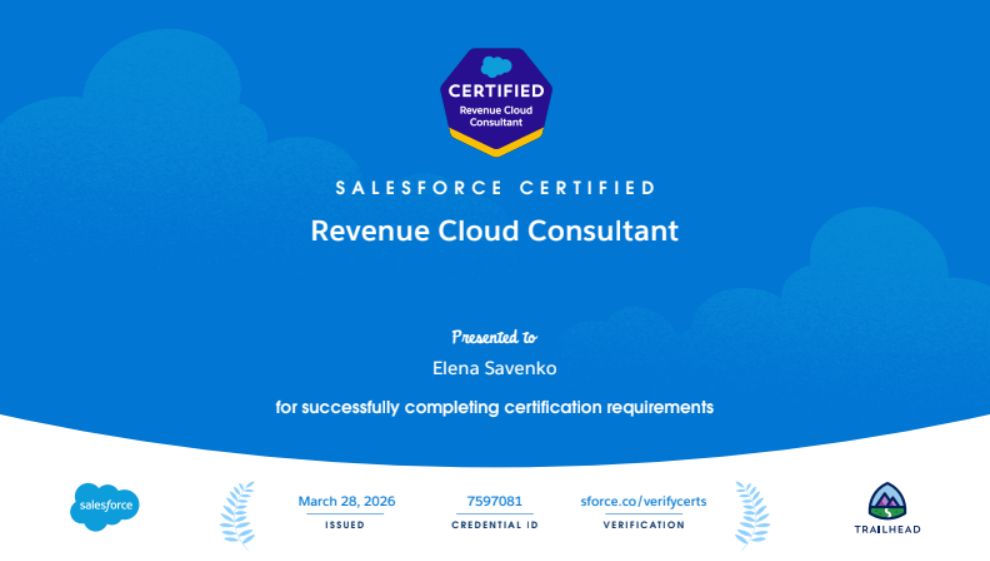
For certification, the Salesforce Certified Revenue Cloud Consultant exam is the current benchmark. It consists of 60 multiple-choice questions plus up to five unscored ones, with 105 minutes to complete it and a 62% passing score, at a $200 registration fee.
Salesforce recommends around two to three years of Product-to-Cash experience going in, though there are no formal prerequisites. If you're mapping out a Salesforce CPQ career transition and already hold a CPQ certification, that background helps with the commercial-logic parts of the exam – the catalog, pricing, and context sections are where CPQ experience alone won't carry you.
5. Go past Trailhead for CML specifically
Reading alone won't get you through CML, though. Trailhead's Product Configurator module covers fundamentals, but production-level CML – table-driven constraints, named constraints, performance tuning – needs a sandbox and, ideally, structured practice with someone who's already debugged a slow solver.
This is the step most learning paths skip. Our CML Training gets your team from concepts to production-ready models.
Certifications and learning paths only matter if they lead somewhere. Before you invest months into PCM, pricing procedures, and CML, it's worth knowing what the market is actually rewarding right now.
Revenue Cloud and CPQ command a premium. Both feature prominently in Salesforce Ben's 2026 Architect Salary Guide, reflecting how much commercial and pricing complexity organizations now expect architects to own.
Demand for architect-level Revenue Cloud skills is growing fast. Technical architect roles are up 27% year-over-year, and solution architect roles up 21% – according to the same survey, based on 2,316 respondents across 76 countries.
Compensation reflects the scarcity. Senior architects in the US report a median salary of $192,500 – a substantial premium over developer and admin compensation, with Revenue Cloud/CPQ specialization among the drivers.
CML sits at the sharp end of that shift. It's a genuinely new paradigm, not an extension of familiar rule-based thinking, so the pool of people who can write CML that's both correct and performant is still small – which is exactly why we called it the hardest skill in Salesforce to learn in an earlier piece.
And my honest perspective: PCM and pricing procedures are learnable in a few focused months. CML competence is currently one of the more defensible specializations in the ecosystem.
Wrapping up
None of this makes CPQ experience worth less. It makes it incomplete on its own. The professionals who move well into Revenue Cloud aren't starting over – they're extending commercial logic they already understand into a lifecycle, a catalog model, and a constraint-based configurator they haven't worked with yet.
That's a learning curve, not a reset, and it rewards people who build the new skills deliberately instead of assuming CPQ experience will carry them through by analogy.
FAQ: Moving from Salesforce CPQ to Revenue Cloud
Is Salesforce CPQ experience still valuable for Revenue Cloud roles?
Yes. The commercial logic – bundles, discounting, approvals, quote-to-cash thinking – transfers directly. What doesn't transfer is the architecture; CPQ patterns copied directly into Revenue Cloud tend to create weak designs.
What's the hardest new skill in this transition?
CML and constraint modeling. It's a declarative paradigm, not an extension of the rule-based thinking CPQ developers already know, and it currently has the smallest pool of experienced practitioners of any Revenue Cloud skill.
Should I get the CPQ Specialist certification or the Revenue Cloud Consultant certification first?
If you're already CPQ certified, that credential still signals real skill – Salesforce hasn't retired it. But new hiring and project demand are weighted toward Revenue Cloud, so the Revenue Cloud Consultant certification is the one worth prioritizing next.
How long does it realistically take to become productive in Revenue Cloud coming from CPQ?
Catalog and pricing concepts are usually workable within a few focused months. CML is the outlier – plan for ongoing sandbox practice well past your first working model, not a one-time ramp-up.
Do I need to learn CML if I work on the admin or functional side, not development?
You need to understand what it does and where it fits, even if you're not writing constraint models yourself. Context definitions and catalog design decisions upstream directly affect whether the CML layer behaves the way the business expects.

%20(3)%20(1).png)
.png)